
- Kraft Heinz benefited from COVID-19 pandemic and regained some lost market share after a high consumer demand for its products.
- Kraft Heinz finished its downtrend with a first quarter growth in revenues.
- For the second quarter, the company expects a low to mid-single digit year over year organic net sales growth.
The Kraft Heinz Company (KHC) is one of the world's largest food and beverage companies with net sales reaching nearly $25 Billion in 2019. Shares of the company have struggled in recent years, however the company managed to outperform the market in the last three months due to higher consumer demand for its products. In fact, sales during the first quarter of 2020 came above market's expectations recording a first sales growth of 3.2% after four consecutive quarters of year-over-year declining sales.
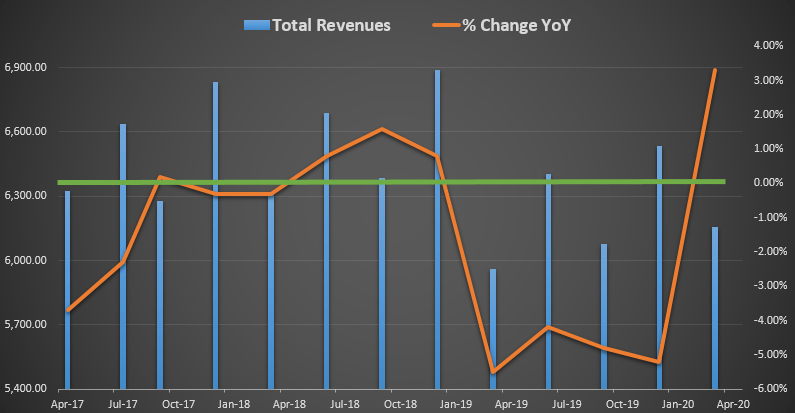
Source: TIKR graph by author
For the second quarter, Kraft Heinz's management expects a low to mid-single digit y-o-y organic net sales growth. We will value the company based on the Free Cash Flow model by making some conservative assumptions. Our model puts the company on the buy list with a price target of $37.98. This investment is suitable for investors seeking reasonable capital gain while maintaining a steady cash income amid a dividend suspension environment.
Strong product mix
Kraft Heinz manufactures and markets food and beverage products spread across different segments and considered essential for consumers. In fact, the recent emergence of the COVID-19 pandemic proved that Kraft's products cannot be eliminated from the consumers' carts. This pandemic has had a positive impact on the company's operations and gave it an opportunity to regain some lost market share. The challenge for Kraft's management lies in taking appropriate measures to move forward and reestablish the upward growth trend. As per their latest earnings call, Kraft Heinz's CEO Miguel Patricio seems confident in managing the current crisis.
The next several months will be critical in understanding the path forward and potential for our industry... Overall, our business is strong. We are operating to peak capacity, performing at world-class levels and leveraging our industry-leading safety, quality and hygiene practices.
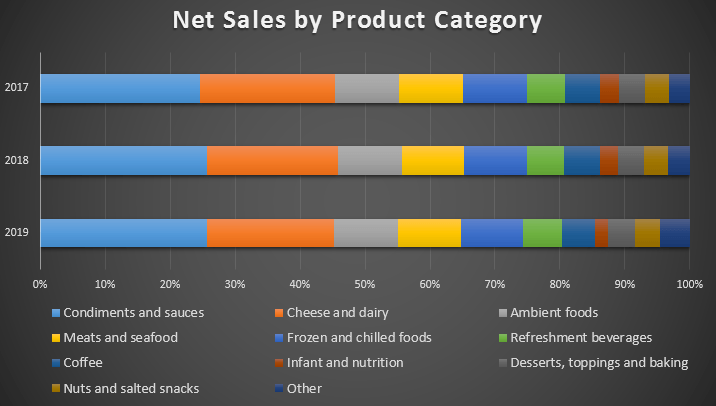
Source: kraft heinz 10k graph by author
Risk factors to be considered
Various risks might impact the business model of Kraft Heinz leading to a substantial hit on the company's bottom line.
- Competition: The company operates in a highly competitive marketplace with a high degree of concentration. Moreover, improving market share and introducing new products requires increased advertising expenditures.
- Brand risk: Having various iconic brands with global recognition increases the company's brand risk which should be managed and extended to new platforms in order to maintain sustainable satisfaction.
- Currency fluctuations: Global presence with a strengthening U.S. Dollar exposes the company to unfavorable currency movements.
In addition to the above major risk factors, high indebtedness levels of the company raises a red flag for investors. Long-term debt of the company stands at $32,773 million, and as shown in the below chart, total debt/EBITDA increased to 6.24x while EBIT/Interest and EBITDA/Interest recorded 3.45x and 4.24x respectively. Those figures assess the company's ability to meet its future debt obligations by relying on its current operating income. The below ratios should be monitored during future periods.

