
Summary
- The company is set to acquire Anixter International in Q2 or Q3.
- The new entity is also expected to double its EPS growth rate and expand its EBITDA margins by 100 basis points.
- We believe there is an opportunity for long-term growth in the combined entity.
- The market is heavily discounting the new capabilities of Wesco post-acquisition.
We see a long-term opportunity in Wesco (WCC) shares. The company is set to acquire Anixter International (AXE) in Q2 or Q3 (pending closing conditions) for what is to be a transformative $4.5B M&A deal.
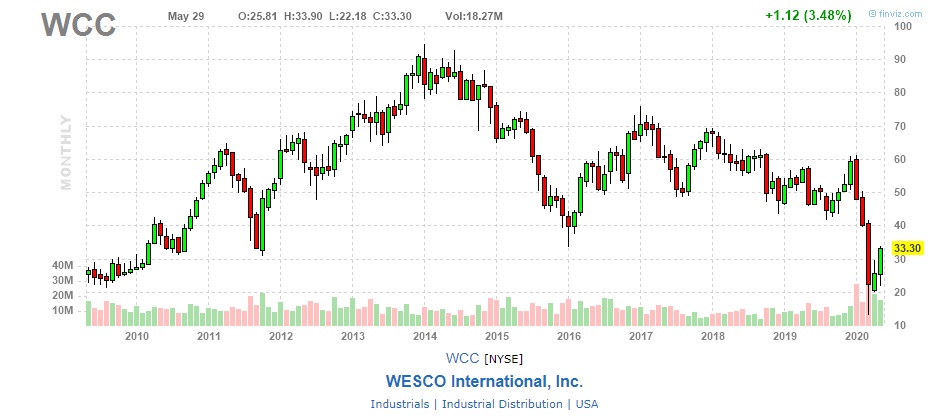
That said, the market doesn’t seem enthusiastic about the acquisition, as reflected in Wesco’s share price. It is not without merit though, as a big acquisition in times of great uncertainty and economic recession, is not a recipe for optimism.
Wesco is taking on a significant amount of debt to finance the acquisition of Anixter. They are offering a combined $2.82B in senior unsecured notes maturing in 2025 and 2028. A challenging environment adds more risks to a levered balance sheet. On a positive note, Wesco debt covenants are very lenient, with no maximum debt leverage covenant. Therefore, any decreases in EBITDA because of recessionary headwinds, which would balloon their debt to EBITDA ratio, is not going to trigger any rapid amortization measures, giving a lot of breathing room for the company to digest the acquisition.
We believe there is an opportunity for long-term growth in the combined entity. The acquisition makes a lot of sense too, as it would fortify the competitive position of Wesco in an industry that is still very fragmented, yet the market is pricing Wesco at a significant discount to its book value, at only 0.64x. Wesco’s 15-year average price to book ratio is 2.3x. The discount gives us an opportunity to acquire shares in a very well-run business.
The combined entity is going to have approximately 13% of the market share
The electrical distribution industry is very fragmented and is estimated to be a $114B industry. Wesco and Anixter, competitors before the acquisition, had less than 7% of market share each. With the two entities combining, on a pro forma basis, the new Wesco is estimated to generate $17B in sales and $1.1B in EBITDA. Although not a direct competitor but a good proxy, W.W Grainger (GWW) had total sales of $11.4B in 2019. Overnight, Wesco is going to double in size once the acquisition gets completed.
The new entity is also expected to double its EPS growth rate and expand its EBITDA margins by 100 basis points. Although it doesn’t seem as much, a 1% expansion in profit margins is a huge improvement, especially since we are talking about a distributor. The distribution business is by nature a low-profit margin business. Also, we are talking about a new Wesco making $17B in sales. Every improvement in margins should be highly accretive to earnings.
The expansion of EPS after the acquisition is attributed mostly to cost synergies. Management estimates cost synergies of $200M after the acquisition. We don’t like the word cost synergy much, but in this case, we believe it makes sense. The two entities have very similar cost structures:

